Brahmin–Dalit caste hierarchy
Serious MenThe Brahmin–Dalit caste hierarchy is the novel’s pervasive ordering of social status, opportunity, and public dignity: it reaches from a grandfather barred from school to arguments over research appointments, religious belonging, and who can imagine a better home. Ayyan Mani reads daily life through this structure and answers its humiliations with anger, irony, and schemes for recognition. The novel also makes clear that an individual reversal of status, or a moment of public attention, does not by itself undo the hierarchy.
Inherited Status and Unequal Opportunity
Ayyan explains his own position through a family history in which caste has concrete consequences. His grandfather was not allowed to enter the village school; when he tried, he was beaten. Ayyan imagines that schooling might have made his own life better, and contrasts that lost opportunity with the scientists at the Institute of Theory and Research, whom he identifies as Brahmins. He describes himself as the son of a sweeper, raised in a one-room home, facing a world whose institutions and accomplishments seem to have been built beyond his reach. His account makes caste more than prejudice between individuals: it is an inheritance that affects who receives education, whose work is valued, and who must struggle to enter spaces shaped by others.
Ayyan’s rhetoric is deliberately expansive and furious. He casts Brahmin advantage as the result of centuries of preparation, contrasting the educated, English-speaking world of the privileged with his own starting point. The force of this comparison lies not in a claim that every Brahmin has an easy life, but in the unequal history against which individual achievement is judged. At the Institute, Jana Nambodri answers criticism of caste privilege with a story of his own hardship: walking five miles to school, going hungry when his father was delayed by a storm, and eventually reaching the top of Indian science. He cites hard work and an IQ of 140, and points to a wealthy Dalit classmate as evidence against treating Brahmins as uniformly privileged. Arvind Acharya’s abrupt question about that IQ unsettles the performance, but the exchange does not resolve the underlying dispute: personal hardship and exceptional cases are being used to argue over a structural imbalance.
Institutional Merit and the Politics of Access
That imbalance becomes explicit in a discussion of quotas for disadvantaged castes in colleges, faculty, and research positions. The prospect that the Institute might be asked to allocate places prompts a sombre response. Ayyan has heard the familiar two-part argument: past wrongs should be corrected and opportunities created, but merit must not be compromised. He imagines Nambodri cleaning a common toilet in the chawls while repeating that defence to his son. The mental picture turns an abstract institutional principle into a test of social position: those who already hold authority can present their own route through education as proof that the system is fair, while the labour and exclusion that structure other people’s lives remain easy to overlook.
Ayyan’s view of opportunity is also shaped by the unequal worlds he encounters outside the Institute. When he sees Oparna Goshmaulik, a high-caste woman who attended Cathedral School and Stanford and now heads Astrobiology, he regards her access to elite education and professional authority as part of the same gulf that separates his household from theirs. His resentment is sharpened by how readily the language of overcoming barriers celebrates some people’s advancement while leaving inherited resources unexamined. The novel sets that perception beside the gendered scrutiny Oparna faces from senior scientists, complicating any simple claim that every person in a privileged group experiences power in the same way.
Religion, Conversion, and Contested Belonging
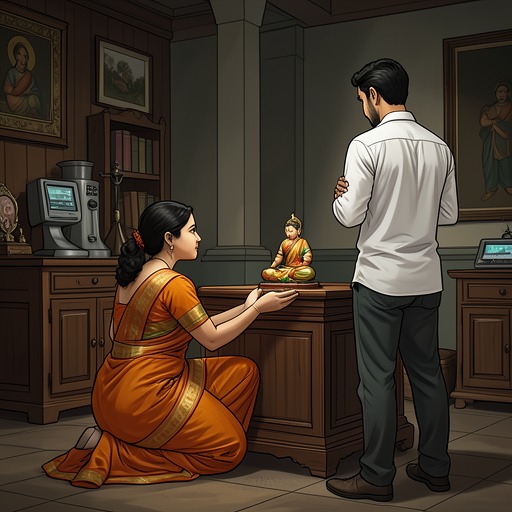
The hierarchy is also fought over inside Ayyan’s home, where religious identity becomes a dispute about who has the right to claim a tradition. When he rolls up a Ganesha idol in newspaper and says he will throw it away, he argues that Buddha is their god and that Brahmin stories cast their forefathers as demons. Oja Mani rejects his account as a complete description of her own faith: she identifies as Hindu and insists that the gods belong to her too. Their argument is not merely about keeping an idol. It exposes the tension between Ayyan’s understanding of Hinduism as inseparable from caste oppression and Oja’s wish to belong to the religion without surrendering its gods to upper-caste authority.
Ayyan invokes Ambedkar as the figure who enabled their rejection of a religion he considers cruel, and declares that they are Buddhists. His position gives conversion the meaning of refusal and reclaimed dignity. Yet it does not settle the family’s differences or erase the pain attached to caste and exclusion. In a later argument about Adi’s hearing impairment, Oja weeps and wonders whether it might not have happened if they had had gods. Her grief connects a personal hardship to the religious protection and security she feels their household lacks; it also reveals how sharply Ayyan and Oja differ over what faith can offer them.
Everyday Hierarchies and the City
The novel gives caste a physical, everyday vocabulary. In Ayyan’s view of Mumbai traffic, cars occupy the highest position, motorcycles come below them, pedestrians lower still, and cyclists are treated as the lowest. The comparison is his satirical interpretation, not a literal account of the road: even amid congestion, he sees people arranged into ranks, with the powerful insulated and those beneath them ignored. He places himself in the bus as lowly but difficult to torment, turning the city’s gridlock into an image of both subordination and endurance.
He pushes that irony further by imagining the Brahmins and other privileged people as clowns in the white man’s eyes, while the crowded streets become a form of Dalit revenge. In this bitter fantasy, those once dominant are trapped in noise and discomfort, and the privileged have nowhere to go but to endure it or flee. The reversal is deliberately unstable: Ayyan can imagine humiliation changing direction, but the traffic still depicts a society organized by rank rather than a society that has escaped ranking. His memories of selling vacuum cleaners in affluent homes deepen the contrast. He saw their spacious buildings and unfamiliar habits from the threshold, learning about lives that seemed easy because their inhabitants had been born into them.
Recognition, Protest, and the Limits of Reversal
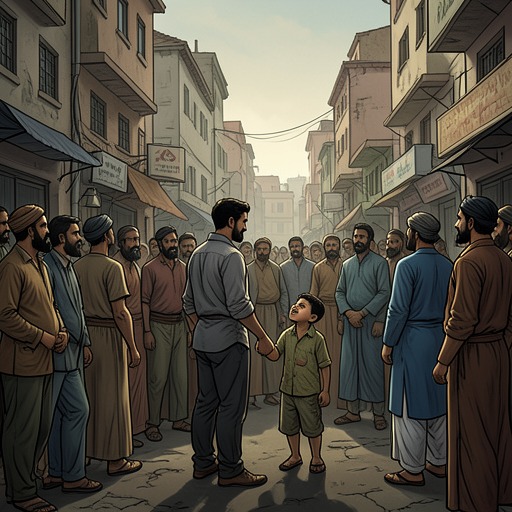
The same gap between material circumstances and public recognition appears when Adi Mani’s supposed genius becomes known in the chawls. Ayyan has secretly coached his son to ask unusual classroom questions, helping construct an image of extraordinary ability around a boy who is also partially deaf. When a newspaper reports that Adi can recite the first thousand prime numbers, neighbours gather around the paper in the toilet queue. The photograph shows a hearing aid, but no one notices that its earpiece is on Adi’s good right ear. People ask Ayyan what their children should learn and what they should eat to become half as bright. For a moment, the family receives affection and respect as the parents of a celebrated child; the attention offers recognition, but it rests on a fabricated achievement rather than a change in the conditions surrounding them.
Ayyan immediately links that attention to the possibility of leaving. He urges a neighbour to sell and move to proper flats, arguing that their children should not have to grow up in what he calls a hell. His hope is collective and material: a better home for the next generation, not merely personal praise. Yet the newspaper’s fame cannot guarantee that move. The episode shows how prestige can briefly alter how a Dalit family is seen while leaving the poverty and crowded living conditions that shape their choices in place.
The account of S. Waman carries caste oppression from routine exclusion into physical violence and political mobilization. In a speech, the minister recalls being tied to a tree by Brahmin priests when he was a boy because he entered a temple; he was left there overnight, then fled his village for Bombay with almost nothing. Ayyan knows the further story of Waman’s rise from selling vegetables to political organizing. Waman becomes skilled at mobilizing angry Dalit youth, sometimes violently, after perceived slights, including the defilement of Ambedkar’s statue with slippers. The narrative records both the insult that provokes collective action and the looting that can follow it. Resistance has force, but it unfolds within a society where formal rights and political representation have not ended poverty or made dignity secure. Across family memory, institutional debate, religious conflict, urban satire, and protest, the hierarchy persists as both a system of unequal access and a contest over who may define what justice would mean.